F5-CrowdStrike Partnership: Why EDR Alone Cannot Protect Modern Network Infrastructure
Understanding the F5-CrowdStrike Strategic Alliance
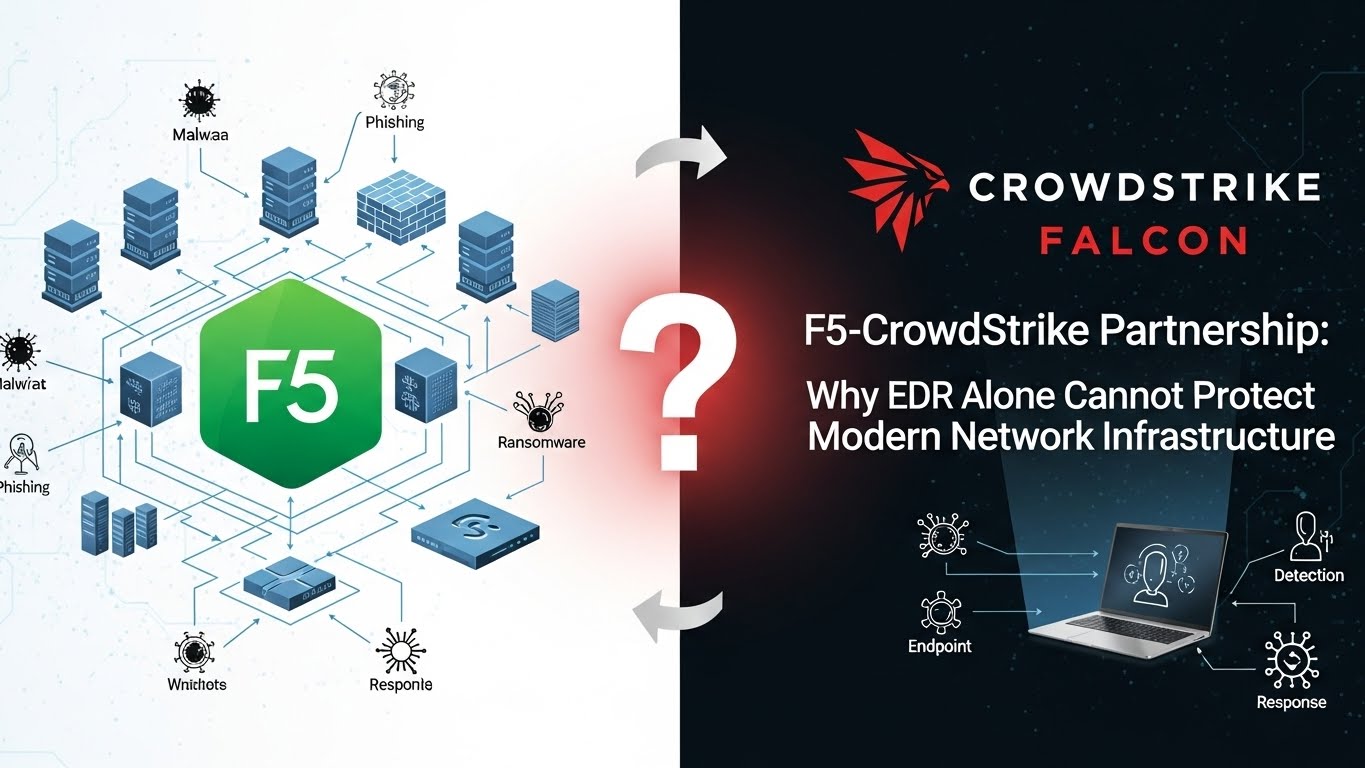
In November 2025, F5 and CrowdStrike announced a groundbreaking partnership that embeds CrowdStrike's Falcon Sensor directly into F5's BIG-IP platform. This strategic alliance represents a significant shift in network security approaches, extending endpoint detection and response (EDR) capabilities to vulnerable network infrastructure that has historically lacked comprehensive protection.
The partnership enables F5 customers to leverage CrowdStrike Falcon's workload security and the Falcon Adversary OverWatch managed threat hunting service across their entire BIG-IP footprint. Notably, eligible BIG-IP customers can deploy these capabilities at no cost through October 14, 2026, providing immediate access to AI-driven security and threat hunting at the network level.
Secure your business and remote users
Get an All-In-One security stack, reduce lateral movement, and monitor every endpoint, fully managed for you. For just $1 per day.
Book a Meeting NowContext Behind the Partnership
This collaboration emerged following a significant security incident. In August 2024, F5 suffered a breach in which nation-state actors reportedly stole segments of BIG-IP source code and vulnerability details. The attack, disclosed in October 2024, underscored the critical vulnerability of network devices and the urgent need for enhanced protection at the network perimeter.
Furthermore, the timing aligns with broader industry concerns. Network device vulnerabilities remain a persistent threat vector, exemplified by recent exploits such as the Fortinet FortiWeb vulnerability capable of remote code execution. With over 200 customers already using Falcon for BIG-IP prior to the official partnership announcement, the demand for network-level security solutions is evident.
The Growing Vulnerability Landscape in 2024-2025
Understanding the current threat landscape provides essential context for why traditional EDR approaches prove insufficient for comprehensive network security. The statistics paint a concerning picture.
Alarming Vulnerability Statistics
According to industry research, 2024 witnessed a record-breaking 40,009 Common Vulnerabilities and Exposures (CVEs) published. This represents a nearly 39% increase from 2023's 28,817 CVEs, demonstrating an exponentially growing attack surface that security teams must defend.
More concerning is the exploitation timeline. VulnCheck reported that 768 CVE-listed vulnerabilities were actively exploited in the wild during 2024, marking a 20% increase from 2023. Additionally, research indicates that by late 2024, the average time for exploitation after a vulnerability's disclosure had dropped to just five days, leaving organizations with minimal time to respond.
Network Security Challenges
Network and device vulnerabilities present unique remediation challenges. According to vulnerability statistics reports, device and network vulnerabilities at high or critical severity levels have an average mean time to remediation (MTTR) of 54.8 days, while application and API vulnerabilities average 74.3 days. This extended remediation window creates significant exposure periods during which attackers can exploit known vulnerabilities.
Furthermore, vulnerability exploitation accounted for 20% of breaches in 2024, based on analysis of over 12,000 confirmed incidents. Research shows that attacks targeting known vulnerabilities surged by 54% compared to the previous year, highlighting the urgency for comprehensive visibility and faster patching capabilities.
Why EDR Alone Falls Short for Network Security
While endpoint detection and response solutions provide critical device-level visibility, relying solely on EDR creates dangerous blind spots in modern distributed environments. Several fundamental limitations constrain the effectiveness of an "EDR everywhere" approach.
Limited Vendor and Platform Coverage
The F5-CrowdStrike partnership currently covers only F5's BIG-IP family of devices. Most organizations operate heterogeneous network environments with multiple network device vendors, including Cisco, Fortinet, Palo Alto Networks, and others. Achieving complete visibility across diverse network infrastructure requires EDR integration across numerous platforms—a goal that remains aspirational in the foreseeable future.
This fragmentation creates visibility gaps where security teams cannot monitor or respond to threats. Without comprehensive coverage, attackers can exploit unprotected network devices as entry points or pivot points within the broader infrastructure.
Scalability and Deployment Challenges
Deploying and maintaining EDR agents across every endpoint presents significant operational challenges. According to cybersecurity research, two critical areas where agent deployment proves particularly difficult include:
- Internet of Things (IoT) Devices: Connected IoT devices often lack the computing resources or operating system capabilities to support traditional EDR agents. As IoT proliferation continues, these devices represent expanding attack surfaces that remain invisible to EDR solutions.
- Cloud Environments: Modern cloud architectures featuring containerized workloads, serverless functions, and ephemeral compute instances create deployment complexities. While some EDR solutions have adapted to cloud environments, coverage gaps persist, particularly in hybrid and multi-cloud deployments.
Organizations cannot protect what they cannot see. When EDR deployment proves impossible or impractical, alternative visibility mechanisms become essential for maintaining security posture.
Vulnerability of EDR Solutions Themselves
EDR solutions face inherent vulnerabilities that sophisticated attackers actively exploit. Several attack vectors specifically target EDR capabilities:
- Evasion Techniques: Attackers employ various methods to bypass EDR detection, including DLL side-loading, code injection, fileless attacks, and memory-based malware. Security research demonstrates that adversaries continuously develop techniques to evade endpoint-level detection.
- Agent Disabling: Once attackers gain access to an endpoint, one of their first actions typically involves disabling EDR agents to obfuscate subsequent activities. This blinds security teams to ongoing malicious operations, allowing attackers to operate undetected during critical phases of their campaigns.
- Living Off the Land (LOTL) Attacks: Threat actors increasingly leverage legitimate system tools and processes to conduct malicious activities. Since these tools exist natively on systems and perform expected functions, EDR solutions struggle to distinguish between legitimate and malicious usage.
The CrowdStrike Outage Lesson
The July 2024 CrowdStrike outage demonstrated the potential disruption when deploying agents on critical systems. A faulty update to the CrowdStrike Falcon sensor caused widespread system crashes affecting millions of Windows machines globally, disrupting operations across airlines, healthcare, financial services, and government agencies.
This incident highlighted a fundamental risk: agent-based security solutions introduce dependencies that, when disrupted, can cause cascading failures across critical infrastructure. For network devices sitting at the core of enterprise connectivity, such disruptions could prove catastrophic.
The Compelling Case for Network Detection and Response (NDR)
Network Detection and Response provides complementary capabilities that address EDR's inherent limitations. Rather than replacing endpoint-level visibility, NDR offers distinct advantages through network-level observation and analysis.
Core NDR Advantages
- Agentless Architecture: NDR solutions operate without requiring software agents on monitored devices. This agentless approach enables coverage across IoT devices, legacy systems, network infrastructure, and cloud environments where agent deployment proves impractical or impossible.
- Out-of-Band Operation: Because NDR operates out-of-band, attackers cannot disable or tamper with the monitoring infrastructure. Unlike EDR agents that reside on potentially compromised endpoints, NDR sensors observe network traffic from separate vantage points, maintaining visibility even when endpoints fall under attacker control.
- Holistic Network Visibility: NDR provides comprehensive observation of network traffic patterns, enabling security analysts to identify lateral movement, data exfiltration attempts, command-and-control communications, and anomalous behavior across the entire network. This holistic perspective reveals attack patterns that remain invisible when examining individual endpoints in isolation.
- Detection of East-West Traffic: While traditional security controls focus on north-south traffic (entering and leaving the network), NDR excels at monitoring east-west traffic between internal systems. Since modern attacks often involve lateral movement within networks, this capability proves critical for detecting advanced threats.
Research-Backed NDR Effectiveness
Recent research from Omdia, titled "The Role of Network Visibility in Protecting Modern Environments," provides quantitative evidence supporting NDR's value proposition:
- Hybrid Cloud Superiority: 41% of surveyed organizations identified NDR or network visibility tools as best equipped to provide visibility across hybrid multi-cloud environments. In comparison, only 12% felt EDR tools were best suited for this purpose—a more than 3:1 advantage for network-based approaches.
- Detection Accuracy: Organizations using network visibility as their first line of defense reported significantly better detection accuracy. Among these organizations, 24% indicated that at least half of their security alerts represented true positive detections of malicious activity. Conversely, organizations relying on endpoint visibility as their primary defense reported only an 11% true positive rate—less than half the effectiveness of network-first approaches.
- Faster Response Times: Nearly two-thirds (61%) of respondents reported that network visibility significantly impacts their ability to move from detection to response, completing this critical transition faster and with greater confidence. An additional 38% indicated moderate positive impact, demonstrating broad consensus on NDR's value for incident response.
- Operational Benefits: Organizations deploying NDR solutions realized tangible improvements across multiple metrics:
- 53% reported improved security operations center (SOC) analyst efficiency
- 49% achieved reduced mean time to detection (MTTD)
- 42% experienced fewer data breaches
These findings demonstrate that NDR delivers measurable security and operational benefits beyond what EDR alone can provide.
NDR Use Cases and Capabilities
Network Detection and Response excels in specific security scenarios:
- Lateral Movement Detection: When attackers compromise an initial endpoint, they typically attempt to move laterally through the network to access additional systems and sensitive data. NDR solutions monitor network traffic patterns to identify unusual connections between systems, detecting lateral movement attempts that EDR might miss.
- Data Exfiltration Prevention: By analyzing network traffic volumes, destinations, and patterns, NDR can identify potential data exfiltration attempts. Unusual data transfers, especially to external or suspicious destinations, trigger alerts that enable security teams to intervene before sensitive information leaves the organization.
- Insider Threat Detection: NDR's ability to establish behavioral baselines for network activity enables detection of insider threats. When authorized users deviate from typical access patterns or transfer unusual data volumes, NDR solutions flag these anomalies for investigation.
- Compliance and Forensics: Network traffic data provides valuable forensic evidence for investigating security incidents and demonstrating compliance with regulatory requirements. The comprehensive network visibility NDR offers supports both reactive investigations and proactive compliance auditing.
Understanding Extended Detection and Response (XDR)
Extended Detection and Response represents the evolution toward unified security platforms that integrate data from multiple sources. XDR solutions combine endpoint, network, cloud, email, and application security data into cohesive systems that provide comprehensive threat detection and response capabilities.
XDR Integration Benefits
- Unified Visibility: XDR platforms aggregate security telemetry from diverse sources, creating a single pane of glass for security operations. This integration eliminates context-switching between disparate tools and enables analysts to investigate incidents more efficiently.
- Correlated Detection: By analyzing data from multiple security layers simultaneously, XDR solutions identify complex attack patterns that span endpoints, networks, and cloud resources. This correlation reduces false positives while improving detection of sophisticated threats.
- Automated Response: XDR platforms often include orchestration capabilities that automate response actions across integrated security tools. When detecting threats, XDR can simultaneously isolate compromised endpoints, block malicious network traffic, and quarantine suspicious cloud resources.
- Reduced Tool Sprawl: Organizations typically deploy numerous point security solutions, creating management complexity and integration challenges. XDR consolidates these capabilities, reducing operational overhead while improving security effectiveness.
XDR Limitations and Considerations
Despite its promise, XDR faces adoption challenges. Many XDR solutions work optimally with products from the same vendor, potentially limiting effectiveness in heterogeneous environments. Organizations must carefully evaluate whether XDR platforms support their existing security infrastructure or require wholesale replacement of established tools.
Additionally, XDR represents a relatively new approach. While major security vendors offer XDR platforms, maturity levels vary, and organizations should thoroughly assess capabilities before committing to specific solutions.
Building a Layered Security Architecture
Security professionals universally recognize that no single solution provides complete protection. Effective cybersecurity requires layered defenses that combine complementary capabilities. The relationship between EDR, NDR, and XDR exemplifies this principle.
The Optimal Security Approach
- Foundation with EDR: Endpoint detection and response remains essential for device-level visibility and control. Organizations should deploy EDR across all compatible endpoints, including desktops, laptops, servers, and mobile devices. EDR provides the granular insight necessary for investigating endpoint-specific threats and enforcing security policies at the device level.
- Network Layer with NDR: Network Detection and Response fills critical visibility gaps that EDR cannot address. By monitoring network traffic, NDR detects lateral movement, identifies compromised devices that evaded endpoint protection, and provides forensic evidence for incident investigation. Organizations should position NDR sensors strategically to observe both north-south and east-west traffic flows.
- Integration through XDR: Extended Detection and Response platforms unite endpoint and network telemetry with additional security data sources. XDR's correlation capabilities enable detection of complex attack chains while automation accelerates response. Organizations with mature security operations should consider XDR to enhance efficiency and effectiveness.
Practical Implementation Recommendations
Based on current research and best practices, organizations should:
- Prioritize Network Visibility: Given NDR's superior performance in hybrid cloud environments and detection accuracy advantages, organizations should emphasize network-level monitoring as a foundational security layer.
- Deploy EDR Strategically: Focus EDR deployment on high-value endpoints and systems where agent installation proves feasible. Accept that universal EDR coverage remains unattainable and plan compensating controls for devices that cannot host agents.
- Address Network Infrastructure Specifically: The F5-CrowdStrike partnership demonstrates growing recognition that network devices require dedicated protection. Organizations should evaluate security options for routers, switches, load balancers, and other network infrastructure components.
- Establish Continuous Monitoring: Both EDR and NDR benefit from continuous operation. Organizations should ensure 24/7 monitoring capabilities, whether through internal security operations centers or managed security service providers (MSSPs).
- Implement Rapid Patching Processes: With average exploitation timelines shrinking to five days, organizations must streamline vulnerability management and patching processes. Network visibility through NDR can help prioritize patches based on actual exploitation attempts observed in network traffic.
Real-World Integration Examples
Security leaders should consider how EDR and NDR work together in practice:
- Scenario 1: Initial Access Detection
When attackers exploit a vulnerability to gain initial access, NDR observes unusual inbound connections or protocol anomalies. Security teams investigate the destination endpoint using EDR to confirm compromise and assess the scope of attacker activity. - Scenario 2: Lateral Movement Prevention
After compromising an initial endpoint and disabling EDR, attackers attempt lateral movement. NDR detects anomalous connections between the compromised system and other network resources, triggering alerts despite the disabled endpoint agent. Security teams can isolate the compromised system before attackers establish persistence on additional devices. - Scenario 3: Data Exfiltration Blocking
Malware on a compromised endpoint attempts to exfiltrate sensitive data. While EDR might detect local file access, NDR observes unusual outbound data transfers and blocks the exfiltration attempt at the network level, preventing data loss even if the endpoint is compromised.
Addressing the F5-CrowdStrike Partnership Limitations
Platform-Specific Coverage
The integration currently supports only F5's BIG-IP platform. Organizations using network devices from other vendors—Cisco, Juniper, Fortinet, Palo Alto Networks, Arista, and others—lack equivalent EDR protection. This creates a patchwork security approach where some network devices receive comprehensive monitoring while others remain vulnerable.
Industry consolidation around common security APIs and standards could eventually enable broader EDR deployment across multi-vendor network environments. However, until such standards achieve widespread adoption, gaps will persist.
EDR Deployment Risks
The CrowdStrike July 2024 outage demonstrated that agent-based security introduces operational risks. Deploying EDR agents on critical network infrastructure—devices that typically prioritize stability and uptime above all else—requires careful consideration. Organizations must balance security benefits against potential availability impacts.
Testing procedures, change management processes, and rollback capabilities become even more critical when deploying security agents on network infrastructure. Organizations should implement controlled rollouts with extensive validation before broad deployment.
Cost and Complexity Considerations
While F5 provides complimentary access through October 2026, organizations must evaluate long-term costs and operational complexity. Managing EDR across network infrastructure adds to existing security tool portfolios, potentially increasing license costs, training requirements, and operational overhead.
Organizations should assess whether extending EDR to network devices provides sufficient value to justify these incremental costs, especially considering that NDR solutions might deliver comparable or superior visibility without requiring agent deployment on every device.
Future Trends in Network Security
The cybersecurity landscape continues evolving, and several trends will shape network security approaches in coming years.
Convergence of Security Tools
Vendors increasingly offer integrated platforms that combine EDR, NDR, XDR, and other security capabilities. This consolidation simplifies management while improving detection through correlation across multiple data sources. Organizations should monitor this consolidation when planning security architecture refreshes.
AI and Machine Learning Enhancement
Both EDR and NDR solutions leverage artificial intelligence and machine learning for anomaly detection and threat identification. As these technologies mature, detection accuracy should improve while reducing false positives that currently burden security teams.
According to industry statistics, 64% of organizations have adopted AI or machine learning in their cybersecurity measures as of 2024, with 95% of security professionals anticipating that AI tools will strengthen their security efforts.
Zero Trust Architecture Adoption
Zero Trust principles assume no implicit trust for any user or device. Implementing Zero Trust requires comprehensive visibility into all network communications—exactly what NDR provides. As organizations embrace Zero Trust architectures, network visibility becomes even more critical.
Cloud-Native Security Evolution
As workloads continue migrating to cloud environments, security solutions must adapt. Cloud-native NDR solutions that leverage cloud provider APIs and telemetry will become increasingly important for maintaining visibility in distributed cloud architectures.
Conclusion: Embracing a Balanced Security Strategy
The F5-CrowdStrike partnership highlights both the importance of securing network infrastructure and the limitations of relying solely on endpoint-based approaches. While EDR provides valuable device-level visibility, it cannot address the complete spectrum of network security challenges.
Research consistently demonstrates that Network Detection and Response delivers superior performance for hybrid cloud visibility, detection accuracy, and incident response speed. Organizations that emphasize network-level monitoring as a foundational security layer, augmented by strategic EDR deployment, achieve better security outcomes than those relying exclusively on endpoints.
The optimal approach combines multiple detection and response capabilities:
- Deploy EDR where feasible to gain deep endpoint visibility and control.
- Implement NDR to monitor network traffic and detect threats that evade or disable endpoint protection.
- Consider XDR to correlate data across security layers and automate response actions.
- Prioritize network visibility based on research showing NDR's effectiveness.
As threat actors grow more sophisticated and attack surfaces expand, organizations cannot afford security blind spots. The layered approach that combines endpoint, network, and extended detection capabilities provides the comprehensive visibility necessary to defend modern distributed environments.
Security teams should evaluate their current architecture against these principles. Organizations over-reliant on EDR should consider adding network visibility capabilities. Conversely, those with strong network monitoring should strategically deploy EDR for endpoint-specific threats. The goal is comprehensive coverage that addresses each security domain's unique requirements while leveraging the complementary strengths of different detection approaches.
In the rapidly evolving threat landscape, there is no silver bullet—but a well-architected security strategy that balances endpoint and network capabilities positions organizations to detect and respond to threats effectively across their entire infrastructure.
Frequently Asked Questions
What is the F5-CrowdStrike partnership and why does it matter?
The F5-CrowdStrike partnership embeds CrowdStrike's Falcon Sensor directly into F5's BIG-IP platform, extending endpoint detection and response capabilities to network infrastructure. It matters because network devices have historically been under-protected, and this integration brings AI-driven security and managed threat hunting directly to critical network layers.
Why is EDR alone not enough to protect modern network infrastructure?
EDR alone is insufficient because it cannot be deployed on every device or environment, including many IoT devices, legacy systems, and some cloud workloads. Attackers can also disable or evade EDR agents. Network Detection and Response (NDR) adds agentless, out-of-band visibility that detects lateral movement, data exfiltration, and other behaviors that endpoints alone might miss.
What advantages does NDR provide over traditional endpoint-centric approaches?
NDR offers agentless coverage, cannot be easily disabled by attackers, provides holistic visibility into east-west and north-south traffic, and delivers better detection accuracy in hybrid cloud environments. It is especially effective at identifying lateral movement, command-and-control activity, and data exfiltration attempts.
How do EDR, NDR, and XDR work together in a layered defense?
EDR covers endpoints, NDR covers network traffic, and XDR unifies signals from both along with cloud and application telemetry. This combination improves detection quality, shortens response times, and reduces blind spots by correlating activity across multiple layers of the environment.
External Resources
For additional information on network security best practices and detection technologies: